Sights & streets in Kyoto · Shijo / Kawaramachi
Nishiki Market
Staying nearby? Where to stay in Kawaramachi & Shijo for getting around →
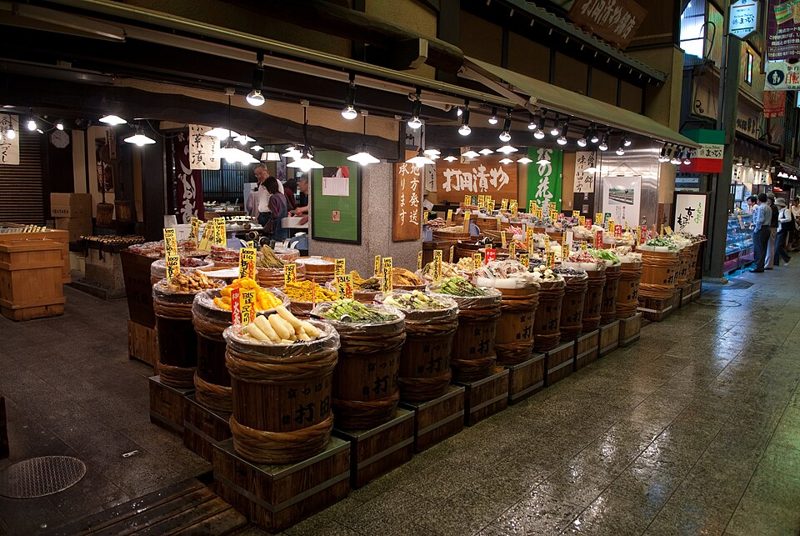
Why did a fish market flourish in the middle of Kyoto? Part of the answer lies underground. Nishiki Market benefited from abundant groundwater, and in 1615 the Edo shogunate officially recognized it as one of Kyoto's fish wholesale markets. Still known as 'Kyoto's Kitchen,' it is also the birthplace of Ito Jakuchu, a celebrated Japanese painter whose family ran a vegetable wholesale business here.
Kyochika's take
Start at the Karasuma end and walk east toward Teramachi-dori, browsing food shops and looking for places associated with Ito Jakuchu along the way. Allow approximately 45–60 minutes for browsing and shopping. The nearby Teramachi and Shinkyogoku shopping streets make an easy addition to the route.
Hours, admission and access
- Access
- Approximately 5 minutes on foot from Hankyu Karasuma, 7 minutes from Subway Shijo, or 5 minutes from the Shijo-Kawaramachi or Shijo-Takakura city bus stops.
- Nearest station
- Karasuma
Checked against official information on 2026-10-28. Details change, so check the official website before you go.
Sources: Nishiki Market Shopping Street Official Website (Japanese), Kyoto City Official Tourism Guide: Nishiki Market Shopping Street (Japanese), Kyoto City Official School Trip Guide: Nishiki Market (Japanese), Kyoto City Official Tourist Information: FAQ (Japanese)
 Pochikichi's story corner
Why Did Nishiki Market Develop in This Particular Street?
The development of Nishiki Market was closely tied to the availability of high-quality groundwater. According to the market association's official history, there are no definitive written records of its earliest days, but it is believed that trading was already taking place here during the Heian period. The abundant water made the area suitable for handling fish and other fresh foods. This relationship between water and commerce helped create the foundations of the market that visitors know today.
In 1615, the Edo shogunate officially recognized three fish wholesale markets in Kyoto: Kami-no-Tana, Nishiki-no-Tana, and Rokujo-no-Tana. Nishiki-no-Tana developed into the present Nishiki Market. As the fish trade expanded, vegetable sellers and merchants dealing in processed foods also established businesses along Nishiki-koji. Today, more than 130 shops line approximately 400 meters of the street between Teramachi-dori and Takakura-dori.
Nishiki Market also has an unexpected connection to Japanese art history. The painter Ito Jakuchu was born into a vegetable wholesale family here, and vegetables and fruits such as daikon radishes, turnips, and lotus roots frequently appear in his work. Images inspired by his paintings decorate parts of the market, and a monument marks the location of his birthplace. Nishiki is therefore more than a place to shop for food: it is a neighborhood that helped shape the imagination of a major Japanese artist. So, as you walk through the market, compare the vegetables on today's stalls with those depicted in Jakuchu's paintings.
Sources: Nishiki Market Shopping Street Official Website: About Nishiki Market (Japanese), Kyoto City Official Tourism Guide: Nishiki Market Shopping Street (Japanese)
Long ago, around hereWhat Was This Street Like Before It Became Kyoto's Kitchen?
The history of Nishiki-koji predates the market itself. According to the market association, the street was once called Gusoku-koji because it was supposedly a place where people removed their equipment before entering the imperial palace. Later, it was known by the less flattering name Kuso-koji, before eventually becoming Nishiki-koji. These changes in its name reveal a surprisingly colorful past behind today's lively shopping street.
After the fish market received official recognition from the shogunate in 1615, Nishiki became an important distribution center for Kyoto's food culture. Its merchants supplied ingredients not only to restaurants and traditional dining establishments but also to ordinary households preparing obanzai, Kyoto-style home cooking. Today the street includes food retailers alongside shops serving travelers and visitors. Yet the relationship with the city's culinary traditions continues. Beneath the covered arcade lies the history of a working wholesale market. So, rather than focusing only on souvenirs and snacks, take time to look at the displays of Kyoto vegetables and fresh fish.
Sources: Nishiki Market Shopping Street Official Website: About Nishiki Market (Japanese), Kyoto City Official School Trip Guide: Nishiki Market (Japanese)
Lesser-Known Highlights
- Birthplace of Ito Jakuchu
- The celebrated Japanese painter was born into a vegetable wholesale family in Nishiki Market. A monument near the western entrance marks the site of his birthplace.
- Jakuchu's Art Around the Market
- Images from Jakuchu's paintings appear on market shutters and decorations. Compare the vegetables in his artwork with the produce sold along the street today.
- Groundwater and the Fish Trade
- One reason the market developed here was the availability of excellent groundwater. Water supported food trading long before the fish market received official recognition in the early Edo period.
- Nishiki Market's Arcade
- The distinctive covered roof features red, yellow, and green panels. Stretching approximately 390 meters, it creates a recognizable streetscape and makes shopping easier on rainy days.
- Connections to the Gion Festival
- Nishiki Market has historical ties to the procession of portable shrines during the Gion Festival. The neighborhood continues to support Kyoto's religious festival traditions as well as its food culture.
Sources: Nishiki Market Shopping Street Official Website: About Nishiki Market (Japanese)
Through the seasons
- Spring
- Seasonal vegetables, fish, and other fresh ingredients used in Kyoto cuisine appear in the market stalls.
- Summer
- In July, Nishiki Market participates in traditions connected with the portable shrine processions of the Gion Festival.
- Autumn
- Look for seasonal Kyoto vegetables and seafood used in autumn cooking.
- Winter
- Browse seasonal ingredients used in traditional Kyoto winter dishes and everyday home cooking.
Good to know before you go
- Eating while walking is prohibited in Nishiki Market. Eat purchases in the shop where they were bought or in a designated eating area.
- There are no unified opening hours for the entire market. Each shop sets its own business hours and closing days.
- The arcade is narrow and can become crowded. Avoid stopping in ways that obstruct other shoppers.
- Kyoto City's official tourism guidance recommends checking individual shop information before visiting.
Next stop: book for later today PR
Experiences near here you can book on Klook.
Nishiki Food TourNishiki Market 3-hour food walking tour→Kyoto Walking TourHalf-day walk: Nijo Castle, Nishiki Market and Gion→Ad: Klook affiliate links.
🍜 Where to eat after
Restaurants near here on Google Maps→Many restaurants in Kyoto take reservations, and some are cash only. Check the restaurant page before you go.
Events nearby
Art exhibition
Eternal Spirits: Go Nagai - Go Nagai Wonderland Revival (Kyoto) at The Museum of Kyoto
The Museum of Kyoto, 3rd-floor gallery (Karasuma Oike Sta.)
Nov 28 (Sat) – Jan 11 (Mon) 10:00 – 18:00 (details on the official site)
An exhibition on Go Nagai, creator of Mazinger Z, Devilman and Cutie Honey. Its core is the original art and figures recovered from the burned Go Nagai Wonderland museum in Wajima after the 2024 Noto Peninsula earthquake. Highlights include the quake-damaged large Great Mazinger figure, the restored Mazinger Z original art, the unrestored Demon Lord Dante art, a display on the Wajima Taisai (Kiriko) festival, and new manga Nagai drew for the show. Advance tickets on sale until Nov 27.
Details →Art exhibition
Tanomura Chokunyu and Modern Kyoto Nanga: Ambience of Nature at The Museum of Kyoto
The Museum of Kyoto, 2F Gallery (Karasuma Oike Sta.)
Oct 3 (Sat) – Nov 29 (Sun) 10:00 – 19:30
Marking 130 years since the Japan Nanga Association was founded and 120 years since the death of its leader Tanomura Chokunyu (1814-1907). Works and materials mainly from the Kyoto Prefecture collection introduce the literati painting of modern Kyoto. Last entry 7:00 PM; closed Mondays (open November 23, closed November 24).
Details →Art exhibition
Special Exhibition: Kan'ei — Beauty Nurtured by an Age of Peace at The Museum of Kyoto
The Museum of Kyoto (Karasuma Oike Sta.)
Sep 19 (Sat) – Nov 15 (Sun) 10:00 – 18:00
Commemorating 400 years since the imperial visit of 1626 during the Kan'ei era, this exhibition explores Kyoto's culture in the early Edo period. Open until 7:30 PM on Fridays.
Details →Art exhibition
Kyoto ddd Gallery Exhibition No. 254: Superplay — Graphic Design from Rotterdam
Kyoto ddd Gallery (Shijo Sta.)
Nov 4 (Wed) – Jan 13 (Wed) Tuesday–Friday 11:00 AM–7:00 PM; Saturdays, Sundays, and public holidays 11:00 AM–6:00 PM
A graphic design exhibition featuring Rotterdam-based studios Studio Spass and Team Thursday.
Details →Nov 1 (Sun) – Nov 23 (Mon) 09:00 – 18:00 (details on the official site)
A City of Kyoto trial linking Pontocho Park to the Kamo River with a temporary staircase, plus chairs and a lawn corner. On Nov 13 and 14 only, food stalls serve craft beer, sake, kamameshi rice, shumai and takoyaki from 11 a.m. to 9 p.m. Rain date: Nov 15.
Details →Food event
Prague Sweets Fair: 30th Anniversary of the Kyoto-Prague Sister City Partnership at Nine pastry shops and cafes across Kyoto
Nine pastry shops and cafes across Kyoto, including Amber Court at Hotel Nikko Princess Kyoto (Shijo Sta.)
Nov 1 (Sun) – Nov 30 (Mon) Hours: please check with the organizer
Kyoto and Prague became sister cities in 1996. For the 30th anniversary, nine shops in the city sell Czech-inspired sweets such as medovnik and vetrnik through November. Hours: please check with each shop.
Details →
Tips from visitors
Been here? Leave a short tip for the next traveler — in any language. No name, no sign-up.
Thank you! We check every tip by hand and post it within a day or two.
How we post tips: we read every one before it goes up. We remove swear words, insults, ads, links and anything that could identify a person. Tips are shown in the language they were written in, with a translate link. Kyochika never writes or pays for tips, and there are no star ratings.
FAQ
- What is Nishiki Market?
- Why did a fish market flourish in the middle of Kyoto? Part of the answer lies underground. Nishiki Market benefited from abundant groundwater, and in 1615 the Edo shogunate officially recognized it as one of Kyoto's fish wholesale markets. Still known as 'Kyoto's Kitchen,' it is also the birthplace of Ito Jakuchu, a celebrated Japanese painter whose family ran a vegetable wholesale business here.
- Access at Nishiki Market?
- Approximately 5 minutes on foot from Hankyu Karasuma, 7 minutes from Subway Shijo, or 5 minutes from the Shijo-Kawaramachi or Shijo-Takakura city bus stops.