Temples in Kyoto · Higashiyama / Gion
Kiyomizu-dera Temple
Staying nearby? Where to stay in Gion & Higashiyama for getting around →
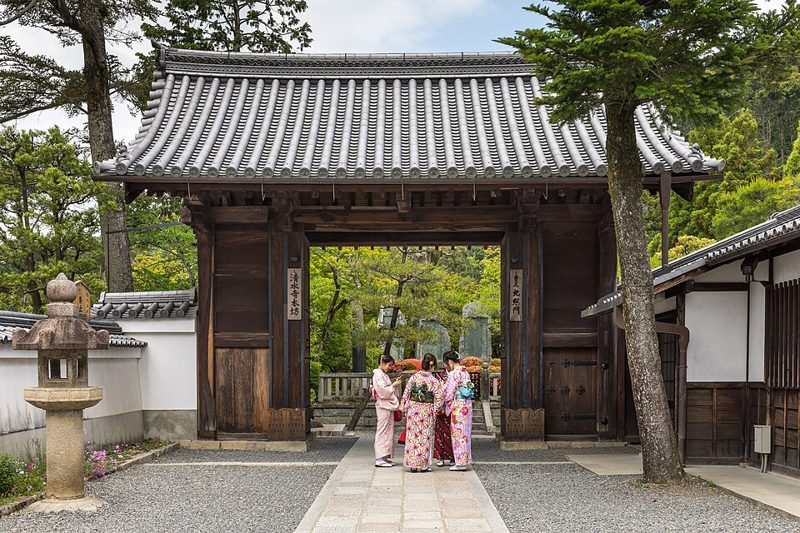
Before Kiyomizu-dera had its famous wooden stage, it had a waterfall. In 778, a monk named Kenshin discovered a sacred spring on Mount Otowa, giving the temple its name, which means 'Temple of Pure Water.' With the support of the warrior Sakanoue no Tamuramaro, the site grew into a major center of Kannon worship. Most of its principal buildings, including the Main Hall, were rebuilt in 1633.
🎧 English audio guide (first track free): Kiyomizu-dera: A Walk Through Time with Pochika and Pochikichi →Kyochika's take
Begin at the Niomon Gate, continue past the Three-Story Pagoda and Main Hall, then visit the Okunoin Hall, Otowa Waterfall, and the Thousand Stone Buddhas. Allow approximately 1–1.5 hours for the temple grounds. Afterward, walk downhill along Kiyomizu-zaka toward Sannenzaka and Ninenzaka to experience the historic streets that grew around this pilgrimage destination.
Hours, admission and access
- Hours
- 2026: 6:00–18:00 from January 1 to March 26, April 6 to June 30, September 1 to November 20, and December 1 to 31. 6:00–18:30 from July 1 to August 13 and August 17 to 31. During special spring, summer, and autumn night openings, the temple closes at 21:30, with last admission at 21:00.
- Closed
- Open daily.
- Admission
- Adults ¥500; elementary and junior high school students ¥200.
- Access
- Approximately 25 minutes on foot from Keihan Kiyomizu-gojo. Approximately 10 minutes on foot from the Gojozaka or Kiyomizu-michi city bus stops.
- Nearest station
- Kiyomizu-gojo
Checked against official information on 2026-10-28. Details change, so check the official website before you go.
Sources: Kiyomizu-dera Official Website: Access and Visiting Hours (Japanese), Saigoku 33 Kannon Pilgrimage: Temple No. 16, Kiyomizu-dera (Japanese), Kiyomizu-dera: Geographic Location Data (Japanese)
 Pochikichi's story corner
Why Was Kiyomizu-dera Built on a Mountainside?
The story of Kiyomizu-dera begins in 778, before Kyoto became Japan's capital. According to the temple's traditional founding account, the monk Kenshin was training in Nara when a dream instructed him to travel north. He eventually reached a clear waterfall on Mount Otowa. There he encountered an elderly hermit named Gyoei Koji, who entrusted him with sacred wood from which to carve an image of Kannon, the bodhisattva of compassion. This encounter became the foundation of a religious sanctuary centered on Otowa Waterfall.
The temple's story then takes an unexpected turn. Sakanoue no Tamuramaro, a prominent military commander, reportedly came to the mountain while hunting deer and met Kenshin. Moved by the monk's teachings, Tamuramaro and his wife, Miyoshi no Takako, helped establish the temple. Its name, Kiyomizu, means 'pure water,' a reference to the mountain spring. Kenshin later took the religious name Enchin. The meeting between a mountain monk and a military commander who would become a shogun is central to the temple's founding tradition.
Kiyomizu-dera has suffered more than ten major fires during its long history. Most of the buildings visitors see today were reconstructed in 1633. The National Treasure Main Hall features the celebrated wooden stage projecting from the mountainside. In 1994, Kiyomizu-dera became part of the UNESCO World Heritage Site Historic Monuments of Ancient Kyoto. Yet the real beginning of this monumental temple was not its architecture but its spring. That is why, after admiring the great wooden stage, you should seek out Otowa Waterfall, where the story began.
Sources: Kiyomizu-dera Official Website: History (Japanese), Kiyomizu-dera Official Website: Precinct Map (Japanese)
Long ago, around hereWhat Was This Neighborhood Like Long Ago?
The slopes of Mount Otowa were a place of mountain asceticism and Kannon worship long before they became one of Kyoto's busiest destinations. The temple was founded in 778, predating the establishment of the Heian capital in 794. According to tradition, Kenshin first lived in a simple hermitage near the waterfall. Over time, this secluded religious retreat became a pilgrimage destination open to ordinary people. Accounts of visits to Kiyomizu-dera eventually appeared in historical writings and literature, revealing how much the mountain sanctuary meant to the people of the capital.
The surrounding area also witnessed destruction and recovery. The Niomon Gate was destroyed by fire in 1469 and rebuilt around 1500, while the temple complex itself underwent repeated reconstruction. During the anti-Buddhist movement of the Meiji era, some stone Buddhist statues formerly worshipped in Kyoto neighborhoods were brought here by residents determined to preserve them. The collection known as the Thousand Stone Buddhas remains a reminder of those efforts. So, beyond the spectacular Main Hall, take a close look at the individual statues in this remarkable gathering of stone Buddhas.
Sources: Kiyomizu-dera Official Website: History (Japanese), Kiyomizu-dera Official Website: Precinct Map (Japanese), Kiyomizu-dera Official Website: Jizo Bodhisattva and Bishamonten (Japanese)
Lesser-Known Highlights
- Thousand Stone Buddhas
- This collection includes stone Buddhist images brought from Kyoto neighborhoods during the Meiji-era anti-Buddhist movement. Each small statue preserves a fragment of local religious history.
- Koyasu Pagoda
- Rebuilt in 1500, this three-story pagoda houses Koyasu Kannon, traditionally worshipped for safe childbirth. It stands away from the Main Hall and is designated an Important Cultural Property.
- West Gate
- Rebuilt in 1633, the gate is associated with Nissokan, a Buddhist contemplation practice in which the setting sun evokes the Pure Land paradise. Its spiritual meaning is as significant as its architecture.
- Bell Tower
- Reconstructed and relocated to its present site in 1607, the tower features elaborate decorative details, including peony ornaments, chrysanthemum motifs, and carvings of mythical beasts and elephants.
- Jojuin Temple
- Originating as the residence of the monk Gana, who helped revive Kiyomizu-dera after the Onin War, Jojuin contains the celebrated Moon Garden. It opens to visitors only during special periods.
Sources: Kiyomizu-dera Official Website: Precinct Map (Japanese)
Through the seasons
- Spring
- Spring special night viewing runs from March 27 to April 5, 2026, with the temple closing at 21:30.
- Summer
- The Sennichi Mairi, or Thousand-Day Pilgrimage, and summer special night viewing take place from August 14 to 16, 2026, with the temple closing at 21:30.
- Autumn
- Autumn special night viewing runs from November 21 to 30, 2026, offering illuminated views of the Main Hall's wooden stage against the autumn foliage.
- Winter
- From December 1 to 31, opening hours are 6:00–18:00.
Good to know before you go
- Some routes suggested by digital maps do not lead to a usable temple entrance. The official website recommends approaching via Kiyomizu-zaka to the Niomon Gate or via Chawan-zaka toward the temple's emergency access road.
- There is no visitor parking inside the temple grounds. Public transportation is recommended.
- Special night-viewing dates change from year to year.
- Jojuin Garden and the Treasure Hall are not permanently open along the regular visiting route.
Next stop: book for later today PR
Experiences near here you can book on Klook.
Sushi CookingHands-on sushi workshop in English→Kimono RentalKimono rental (Kyoto Aiwafuku, free hair styling)→Ad: Klook affiliate links.
🍜 Where to eat after
Restaurants near here on Google Maps→Many restaurants in Kyoto take reservations, and some are cash only. Check the restaurant page before you go.
Events nearby
Festival & seasonal event
Autumn Special Night Viewing at Kiyomizu-dera Temple
Kiyomizu-dera Temple (Kiyomizu-Gojo Sta.)
Nov 21 (Sat) – Nov 30 (Mon) 17:30 – 21:30
Special evening viewing with illuminated autumn foliage in Kin'un Gorge and the National Treasure Main Hall. Last admission at 9:00 PM; gates close at 9:30 PM.
Details →Festival & seasonal event
Kiyomizu-dera Jojuin Garden Special Viewing (Autumn Nights)
Jojuin, Kiyomizu-dera Temple (Kiyomizu-Gojo Sta.)
Nov 21 (Sat) – Nov 30 (Mon) 18:00 – 20:30
The garden of Jojuin, a sub-temple of Kiyomizu-dera, opens at night during the same period as the main temple's autumn night viewing. Admission closes at 8:30 PM.
Details →Art exhibition
Autumn 2026 Exhibition: Sakamoto Ryoma and the Satsuma-Choshu Alliance at Ryozen Museum of History
Ryozen Museum of History (Bakumatsu Ishin Museum) (Gion-Shijo Sta.)
Sep 16 (Wed) – Nov 23 (Mon) Last entry 17:00. Closed Mondays (open November 2 and 23)
An exhibition for the 190th anniversary of Sakamoto Ryoma's birth and the 160th anniversary of the Satsuma-Choshu Alliance. It introduces recent research that re-examines Ryoma's role using records from Satsuma, Choshu and the shogunate. The second period runs from October 27.
Details →Oct 23 (Fri) – Dec 13 (Sun) 17:00 – 22:00
See illuminated autumn gardens at Kodaiji, founded by Nene, the wife of Toyotomi Hideyoshi. Projection mapping also transforms the garden in front of the Hojo Hall. Last admission at 9:30 PM.
Details →Art exhibition
Entokuin Temple: Teikan-zu Folding Screens and Autumn Night Light-Up
Entokuin Temple (Kodaiji sub-temple) (Gion-Shijo Sta.)
Oct 23 (Fri) – Dec 13 (Sun) 10:00 – 22:00
The sub-temple of Kodaiji where Nene, the wife of Toyotomi Hideyoshi, spent her final years. It shows the Teikan-zu folding screens handed down in the Toyotomi family, and in autumn lights up its pond-stroll and dry landscape gardens at night. Lights come on at 17:00, last entry is 21:30 and the gate closes at 22:00, with no day/night changeover. Closed December 11 and 12 for temple services.
Details →Art exhibition
Chorakuji Temple Autumn Special Exhibition (with evening viewing)
Chorakuji Temple (behind Maruyama Park, Higashiyama) (Higashiyama Sta.)
Nov 1 (Sun) – Dec 13 (Sun) 10:00 – 17:00 (details on the official site)
An autumn display of temple treasures at Chorakuji, set midway along Kyoto's Higashiyama hills. See seven Important Cultural Property statues of the Jishu sect's Yugyo-shonin leaders, starting with founder Ippen, and a letter from the Ashikaga family. Evening viewing runs 6:00–8:00 PM from November 23 to December 6.
Details →
Tips from visitors
Been here? Leave a short tip for the next traveler — in any language. No name, no sign-up.
Thank you! We check every tip by hand and post it within a day or two.
How we post tips: we read every one before it goes up. We remove swear words, insults, ads, links and anything that could identify a person. Tips are shown in the language they were written in, with a translate link. Kyochika never writes or pays for tips, and there are no star ratings.
FAQ
- What is Kiyomizu-dera Temple?
- Before Kiyomizu-dera had its famous wooden stage, it had a waterfall. In 778, a monk named Kenshin discovered a sacred spring on Mount Otowa, giving the temple its name, which means 'Temple of Pure Water.' With the support of the warrior Sakanoue no Tamuramaro, the site grew into a major center of Kannon worship. Most of its principal buildings, including the Main Hall, were rebuilt in 1633.
- Hours at Kiyomizu-dera Temple?
- 2026: 6:00–18:00 from January 1 to March 26, April 6 to June 30, September 1 to November 20, and December 1 to 31. 6:00–18:30 from July 1 to August 13 and August 17 to 31. During special spring, summer, and autumn night openings, the temple closes at 21:30, with last admission at 21:00.
- Closed at Kiyomizu-dera Temple?
- Open daily.
- Admission at Kiyomizu-dera Temple?
- Adults ¥500; elementary and junior high school students ¥200.
- Access at Kiyomizu-dera Temple?
- Approximately 25 minutes on foot from Keihan Kiyomizu-gojo. Approximately 10 minutes on foot from the Gojozaka or Kiyomizu-michi city bus stops.