Shrines in Kyoto · Higashiyama–Gion
Yasaka Shrine
Staying nearby? Where to stay in Gion & Higashiyama for getting around →
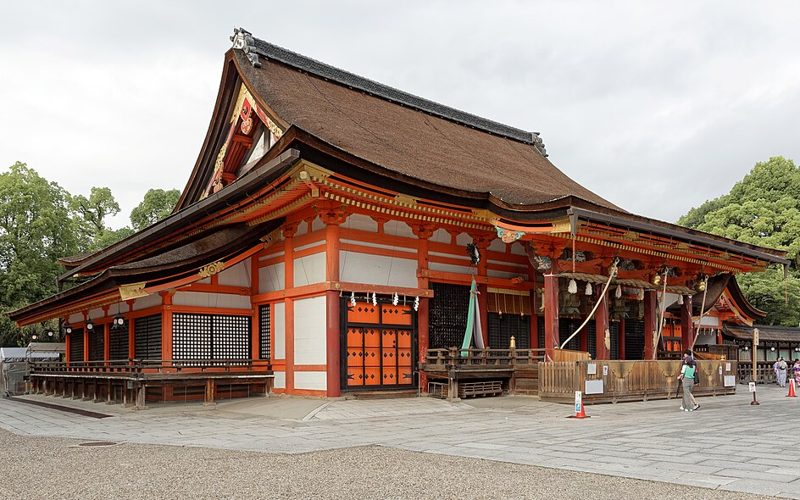
Standing at the eastern end of Gion's Shijo Street, Yasaka Shrine is the spiritual home of the Gion Festival, Kyoto's great summer celebration. The festival grew from prayers to stop devastating epidemics during the Heian period. Before the Meiji era, this was also a Buddhist religious complex, and its present National Treasure main sanctuary dates from the time of Tokugawa Ietsuna.
Kyochika's take
Enter from Shijo Street through the West Gate, visit the main sanctuary, then walk around to the South Gate and its stone torii. This route reveals that the entrance most visitors photograph is not the shrine's formal main entrance. Allow about 30–50 minutes, and combine your visit with Maruyama Park and a walk through historic Gion.
Hours, admission and access
- Hours
- Shrine grounds open 24 hours. Shrine office: 9:00–17:00.
- Admission
- Free entry to the shrine grounds
- Access
- Approximately 5 minutes on foot from Gion-shijo on the Keihan Railway, or 8 minutes from Kyoto-kawaramachi on the Hankyu Railway.
- Nearest station
- Gion-shijo
Checked against official information on 2026-10-28. Details change, so check the official website before you go.
Sources: Yasaka Shrine: Grounds Map and Access (Japanese), Yasaka Shrine: Highlights of the Grounds (Japanese), Yasaka Shrine: History (Japanese)
 Pochikichi's story corner
Why was Yasaka Shrine once called Gion Kanshin-in?
There are several accounts of how Yasaka Shrine began. One shrine tradition says that in 656, a man named Iri-shi, who had arrived from Korea, enshrined the deity Susanoo-no-Mikoto here. Another tells of the monk Ennyo, who built a Buddhist hall in 876, when the deity of Gion was said to have appeared at the foot of the Higashiyama mountains. These are traditional accounts, and neither can be established as the definitive historical beginning of the shrine.
Fear of disease played an important part in the shrine's development. During an epidemic in 877, prayers were offered to the deity of Gion, and tradition says that the outbreak subsided. Susanoo became associated with Gozu Tenno, a protective deity in Buddhist belief, and the religious complex came to be known as Gion Kanshin-in. It combined Shinto and Buddhist worship, and its grounds once included Buddhist halls and a bell tower.
In 1868, government policies separating Shinto from Buddhism led to the adoption of the name Yasaka Shrine. Buddhist images and objects were moved to nearby temples, changing the appearance of the grounds. The present main sanctuary was built in 1654 by order of Tokugawa Ietsuna, the fourth Tokugawa shogun, and designated a National Treasure in 2020. As you explore, look for traces of the time when Buddhist and Shinto traditions shared this sacred site.
Sources: Yasaka Shrine: History (Japanese), Yasaka Shrine: About the Shrine (Japanese)
Long ago, around hereWhat was this neighborhood like long ago?
The foothills of Higashiyama, where Yasaka Shrine stands, formed part of Kyoto's sacred eastern landscape. In 1070, an official government decree recognized an extensive area as belonging to the religious complex of Gion Kanshin-in. Its territory stretched from the Shirakawa mountains in the east to the Kamo River in the west, and from Sanjo in the north to Gojo in the south. Today Gion is famous for entertainment and sightseeing, but in medieval Kyoto this was a district dominated by powerful religious institutions.
During the Edo period, teahouses operated within the shrine grounds, connecting religious visits with the everyday social life of the city. Across from today's Nakamura-ro restaurant stood another teahouse called Fujiya. Together they were known as the Two Teahouses. The streets used by the portable shrines during the Gion Festival also connected the sacred grounds with the surrounding community. When walking through Gion, look beyond the familiar West Gate to the southern stone torii and the history of the old teahouses.
Sources: Yasaka Shrine: History (Japanese), Yasaka Shrine: Highlights of the Grounds (Japanese)
Lesser-known things to discover
- South Gate
- Unlike the famous West Gate facing Shijo Street, this is the formal main entrance. The Gion Festival's portable shrines and wedding processions depart from here.
- Stone Basin at the West Purification Pavilion
- The stone basin retains the inscription Kanshin-in, a reminder of the time when the shrine was also a Buddhist religious complex.
- Lanterns of the Dance Pavilion
- Lanterns donated by Gion teahouses and restaurants hang around the pavilion. During the Gion Festival, three portable shrines are placed here.
- The Well Associated with Kuya
- According to tradition, the monk Kuya used water from this well to provide hot drinks to people suffering from illness during Emperor Daigo's reign.
Sources: Yasaka Shrine: Highlights of the Grounds (Japanese), Yasaka Shrine: History (Japanese)
Through the seasons
- Spring
- Cherry blossoms in neighboring Maruyama Park are highlighted by official visitor information.
- Summer
- The Gion Festival takes place in July, continuing the tradition of prayers for protection against epidemics.
- Autumn
- Autumn foliage can be enjoyed in the surrounding Maruyama Park area.
- Winter
- The Okera Pilgrimage, a traditional year-end ritual, is held at the shrine.
Good to know before you go
- The shrine grounds are accessible 24 hours a day, but the shrine office operates from 9:00–17:00.
- There is no visitor parking on the shrine grounds. The official website directs drivers to nearby parking facilities.
- The famous West Gate facing Shijo Street is different from the South Gate, which is the formal entrance.
- The shrine's official visitor guidance explains the custom of purifying yourself at the water basin before worship.
Next stop: book for later today PR
Experiences near here you can book on Klook.
Kimono RentalKimono rental (Kawai, Kyoto)→Gion Walking TourGion and Yasaka Pagoda small-group walking tour→Ad: Klook affiliate links.
🍜 Where to eat after
Restaurants near here on Google Maps→Many restaurants in Kyoto take reservations, and some are cash only. Check the restaurant page before you go.
Events nearby
Art exhibition
Martine Franck: A Gaze on Her Time (Kahitsukan Kyoto Museum of Contemporary Art)
Kahitsukan Kyoto Museum of Contemporary Art (Gion-Shijo Sta.)
Oct 3 (Sat) – Jan 17 (Sun) 10:00 – 18:00 (details on the official site)
Sixty signed original prints by Magnum photographer Martine Franck (1938–2012) from the Kahitsukan collection, including candid portraits of her husband, Henri Cartier-Bresson.
Details →Art exhibition
Entokuin Temple: Teikan-zu Folding Screens and Autumn Night Light-Up
Entokuin Temple (Kodaiji sub-temple) (Gion-Shijo Sta.)
Oct 23 (Fri) – Dec 13 (Sun) 10:00 – 22:00
The sub-temple of Kodaiji where Nene, the wife of Toyotomi Hideyoshi, spent her final years. It shows the Teikan-zu folding screens handed down in the Toyotomi family, and in autumn lights up its pond-stroll and dry landscape gardens at night. Lights come on at 17:00, last entry is 21:30 and the gate closes at 22:00, with no day/night changeover. Closed December 11 and 12 for temple services.
Details →Nov 17 (Tue) – Dec 6 (Sun) 17:30 – 21:30
The illuminated highlights of the head temple of Jodo Buddhism include the Sanmon Gate, Yuzen-en Garden, and Miei-do Hall. In 2026, visitors can also access the corridor on the upper level of Sanmon Gate. Last admission at 9:00 PM.
Details →Oct 23 (Fri) – Dec 13 (Sun) 17:00 – 22:00
See illuminated autumn gardens at Kodaiji, founded by Nene, the wife of Toyotomi Hideyoshi. Projection mapping also transforms the garden in front of the Hojo Hall. Last admission at 9:30 PM.
Details →Art exhibition
Chorakuji Temple Autumn Special Exhibition (with evening viewing)
Chorakuji Temple (behind Maruyama Park, Higashiyama) (Higashiyama Sta.)
Nov 1 (Sun) – Dec 13 (Sun) 10:00 – 17:00 (details on the official site)
An autumn display of temple treasures at Chorakuji, set midway along Kyoto's Higashiyama hills. See seven Important Cultural Property statues of the Jishu sect's Yugyo-shonin leaders, starting with founder Ippen, and a letter from the Ashikaga family. Evening viewing runs 6:00–8:00 PM from November 23 to December 6.
Details →Live music
Kichirei Kaomise Kogyo (December Grand Kabuki), Minamiza
Minamiza Theatre (Gion-Shijo Sta.)
Dec 1 (Tue) – Dec 24 (Thu) 10:30 – 21:10
Kyoto's year-end kabuki tradition. Matinee from 10:30 AM (ends around 3:15 PM), evening show from 4:00 PM (ends around 9:10 PM). The matinees on Dec 12, 19 and 20 and the evening show on Dec 18 are private bookings.
Details →
Tips from visitors
Been here? Leave a short tip for the next traveler — in any language. No name, no sign-up.
Thank you! We check every tip by hand and post it within a day or two.
How we post tips: we read every one before it goes up. We remove swear words, insults, ads, links and anything that could identify a person. Tips are shown in the language they were written in, with a translate link. Kyochika never writes or pays for tips, and there are no star ratings.
FAQ
- What is Yasaka Shrine?
- Standing at the eastern end of Gion's Shijo Street, Yasaka Shrine is the spiritual home of the Gion Festival, Kyoto's great summer celebration. The festival grew from prayers to stop devastating epidemics during the Heian period. Before the Meiji era, this was also a Buddhist religious complex, and its present National Treasure main sanctuary dates from the time of Tokugawa Ietsuna.
- Hours at Yasaka Shrine?
- Shrine grounds open 24 hours. Shrine office: 9:00–17:00.
- Admission at Yasaka Shrine?
- Free entry to the shrine grounds
- Access at Yasaka Shrine?
- Approximately 5 minutes on foot from Gion-shijo on the Keihan Railway, or 8 minutes from Kyoto-kawaramachi on the Hankyu Railway.